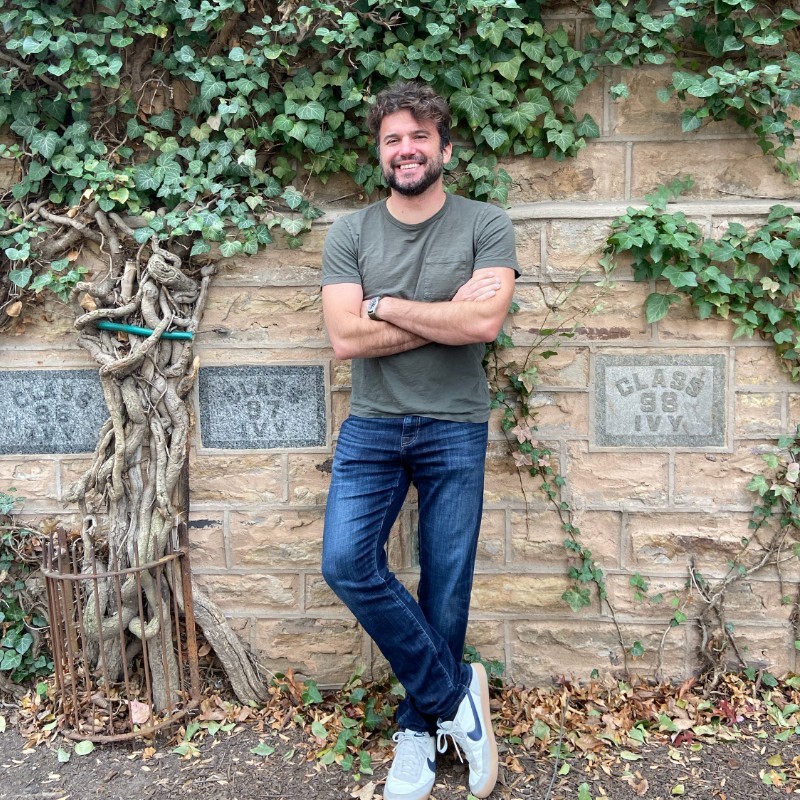
AJ Smith
Outlander VC
AJ brings a genuinely distinctive lens to venture. He built defense tech at 16, opened for the Eagles on violin, and had Glenn Fry as a songwriting mentor. That creative background directly shapes how he coaches founders on storytelling: take the biggest, most complex engineering idea in the universe and get it stuck in everybody's head in the shower. It's not just a metaphor for him. It's the actual skill he evaluates when a deck lands in his inbox. He spends about 90 seconds on a pitch deck, and if he can't understand the business by reading headline to headline across 10-15 slides, it's a pass. That "headline test" is one of the more concrete, actionable pieces of pitch deck advice we've gotten on the show so far.
On process, AJ is refreshingly direct. Outlander reviews over 5,000 deals a year and invests in about 15, writing checks from $500K to $2.5M as a true pre-seed lead. Their diligence is deeply relationship-driven. They use a 20-point founder assessment framework and spend 10-15+ hours getting to know founders before committing, which AJ compares to spending at least as much time together as contestants on The Bachelor before getting married. He also pushes back on the common "tight two-week process" claim, noting that manufactured urgency is usually transparent and can backfire. Instead, he recommends honest momentum building, stating where you actually are with other investors and letting that naturally create urgency.
One of the most valuable threads in this episode is AJ's take on what happens after the round closes. He warns against the post-raise "I can conquer the world" trap, where founders lose focus and try to do everything at once. But the bigger issue he flags is founders hiding problems from their investors. Outlander has helped navigate co-founder breakups, toxic early hires, and product failures, but only when founders are honest about what's going wrong. His blunt advice: save the rose-colored glasses for your customers and your grandma, and give your investors the truth.
On coaching founders to tell a better story
On building thick skin for the fundraising grind
On the pitch deck "headline test"
On building honest urgency without killing the deal
On being transparent with your investors after closing
Mat Vogels (00:10)
Hey everybody, welcome to another episode of Fundraising, a podcast where we interview top early stage investors and ask them all the questions that you want to know about the fundraising process. And today I have very special guest, AJ Smith, investing partner at Outlander VC.
We talked a little bit before, I'm expecting a little bit of spice and authenticity to this one and I think that you are going to deliver on that, because that's what the founders are here for. But before we jump into the fundraising process, AJ, can you give a quick background on Outlander VC, specifically what you're investing in, average check size and maybe the stages that you invest in?
AJ Smith (00:49)
Yeah, 100%. So I mean, first of all, we are a generalist fund. So we will basically look at everything. There are a couple areas we don't touch. My personal focus is a lot in deep tech. you know, AI robotics, autonomy, defense, aerospace, advanced manufacturing, looking a lot of energy, industrial infrastructure. So, you know, basically companies solving really hard technical problems and like big consequential markets. But generally, mean, we I'm just as likely I tell founders to do it.
Mat Vogels (00:59)
Thanks.
AJ Smith (01:16)
awesome vertical AI deal where I believe that there's a big data defensibility advantage as I am to do something in the future of manufacturing. At the end of the day for us, we invest at pre-seed and seed big checks really early. We are a true pre-seed lead. And so that means that I might write a million and a half into an idea for the right founding team. And so when I say the right founding team, for us at Outlander, we dig in hard with our founders. We build a relationship with them. We actually have a 20 point
framework that we are assessing our founders across in order to figure out, is this a fit? Are you an outlander founder? And at the end of that process, that can end up with a mill and a half to really 500K to two and a half are the check size ranges, 10 to 20%. Again, back to being a true lead at the pre-seed, but yeah, that's kind of who we are.
Mat Vogels (02:05)
I love it. Thank you for that. I think that the.
The ability to be flexible across those things is a superpower that I think a lot of funds have the ability to invest in a lot of things at different check sizes and ranges is a huge value add that founders will appreciate as well. All right. Let's go a little bit into more on your background. These are questions that founders wanted to know about the VCs that we talk with. The first being why did you choose to get into to VC? Maybe as a little bit of context I find that VCs have a vast variety of backgrounds but they're almost
always really exceptional people that could do almost anything. Why did you get into VC and then what were you doing before?
AJ Smith (02:44)
Yeah, 100%. So I mean, first of all, I got into VC and specifically with Outlander, I was investing in startups before this as well through a different fund. But I specifically joined Outlander in part because I was looking at, where can I invest and write big checks really early and learn how to be one of the best in venture? And, know, Paige, founder of the fund, Laura, the rest of the team here, I mean, our team has 18 unicorns out of about 150, 160 investments. And so when you're looking at, you know, a hit rate that high,
to me that signals, if I want to be the best, I need to go work with the best. The people that are experts in identifying founder talent this early and were such an accessible fund that that was the draw to me. And then backing up, I'll go way, way back. I was building Defense Tech at 16 years old at the Naval Research Lab. I was selling computer games for the TI-83 and everything like that to all my friends and like, you know.
Mat Vogels (03:37)
Yeah.
AJ Smith (03:38)
games to not pay attention in math class, because I wasn't paying attention in math class. I finished all my math stuff super early. So was going out to the Naval Research Lab building, you know, like infrared sensors and writing all that, like nighttime correction and object detection stuff. Simultaneously parallel path. This is good. I don't know if there's going to be a first on on this or not, but I also had a pretty interesting career in the music industry. So I was a young associate to the National Symphony on violin. Boom, let's go.
Mat Vogels (04:02)
First time, first time.
AJ Smith (04:05)
so yeah, I was a young associate with the national symphony on, on violin, which a lot of people think is weird. The whole like comp sci engineering meets music to me, it's, it's very similar. I'll get into that in a bit, but, that always gave me a bit of an entrepreneurship mindset because, you know, gigging, playing around, playing shows, writing songs, fast forward, went to NYU. I got my first exposure to startups and, know, joined a, I was an early engineer at,
Mat Vogels (04:15)
Yeah.
AJ Smith (04:32)
crypto company in 2012. And super, super awesome. Wild time. was insane. Our CEO got arrested at the airport. It was that era. And my buddy there turned to me and goes, Hey, do you want to be my technical co founder? And I was like, Yeah, that sounds amazing. Now parallel path. I was also
Mat Vogels (04:40)
Uh-huh.
AJ Smith (04:52)
now starting to do some cool stuff in the music industry. was getting to open for the Eagles. was getting to open for Lindsey Stirling on violin. Yeah, Glenn Fry was my mentor over there, rest in peace. And actually, he would tell me songwriting is basically taking big ideas and putting them into small spaces, right? And so how I've translated that over the years is, okay, your job as a songwriter or storyteller is to take some of the biggest abstract most
Mat Vogels (04:57)
wow.
AJ Smith (05:19)
emotional concepts in the universe and then boil that down to a three and a half minute song that gets stuck in your head in the shower. Right. And so now when I tell my founders, when I'm getting ready to take them out to go raise is like, okay, so here's our job. I want you to take some of the biggest, most complex engineering ideas in the universe and let's get it stuck in everybody's heads in the shower. So at the end of the day, life is storytelling. There's a whole other, you know, episode we could do on that, but to fast forward.
Mat Vogels (05:26)
I love that.
AJ Smith (05:44)
Music career was really cool. got to write a bunch of charting songs and do some cool stuff there. I never wanted to be a starving musician, though there were definitely times when I was very starving and sleeping in the car during that journey, but I was coding. And that sort of dual skill set enabled me to have a really cool just two path career that to me merges really well in venture. I've been down the founder road that requires a lot of creativity.
Mat Vogels (05:57)
Hmm.
AJ Smith (06:10)
I had been down the music road that requires a lot of creativity. You're a small business owner as well there. And ultimately like seven years ago, I started investing in startups and that's where I got to see the perfect melding of my worlds. And it's been awesome and I've been loving it ever since.
Mat Vogels (06:15)
Yeah.
This is one of the more common ones we had founders asking us was, what is your favorite part about the job and being a VC? And then what is your least favorite part about the job?
AJ Smith (06:35)
Ooh, well, so my favorite part, hands down, I get to talk with brilliant people who are sharing the best ideas that they've ever had with me every single day. And, you know, so many are just on the cutting edge of what's possible and I'm getting to help see around the corner of possibility and then help enable that, which is just amazing. Like, I feel like I'm getting to like, let's go back in time. It's as if I'm getting to work with Thomas Edison every single day. It's awesome.
My least favorite part of the job is honestly, I talk with thousands of founders a year. We at Outlander, reviewing, we're actually in our top of funnel that we bring in, not even counting the rest of the universe of startups that we look at that we don't end up taking a first real pass at. But we review at least over 5,000 deals a year. From those, we're doing 15 deals. And so my least favorite part, I would say,
Mat Vogels (07:24)
Yeah.
AJ Smith (07:28)
After the first conversation, it's pretty easy to just go ahead, you know what, it's not a fit and I wish you the best of luck genuinely, because I do. Like you have the balls to go out there and go and like build something that you believe in. That's fricking awesome. A lot of people in life never have the gumption to do that, right? But my least favorite part is when we've gone deep with a founder and I have to say, you know, we just couldn't get there.
And a lot of times because our process, again, going back to our founder framework, it's very different. I'm having very deep, intentional conversations with founders asking questions they've probably never been asked before, which is an amazing experience for them and for us. But it's hard when you've built that close up relationship throughout maybe 10, 15 hours together. And then when you have to say, hey, it's still not a fit for us, we're not the best investor for you here. That can suck.
Mat Vogels (08:15)
Yeah. Yeah. And we'll, we'll dive into that later in the process too, on what are the reasons that VCs are typically saying no or passing that late, but it is hard. And like you mentioned, it's the vast majority of the time too, which is also unfortunate about why we choose to do this. All right. Last question here before we dive into the fundraising process, why should founders pick you and or Outlander to be on their cap table?
AJ Smith (08:38)
Yeah, well, first of all, I'm picking Outlander just because we have an incredible track record of helping build multi-billion dollar companies from nothing. All right, so like we've been there, we've seen every possible iteration of drama almost just about. And if it's something new, like we're ready to get in the arena with you and figure it out together. I think the other reason to just choose Outlander as a whole, you know, we're now...
Mat Vogels (08:53)
Hahaha
AJ Smith (09:01)
not just, you know, one check one time, like we do follow on and we have, you know, an opportunity fund actually specifically for coming in down the road down the road as well. And the thing that I want founders to take away from that, because I know that there's others that do follow on investing in all of that. Our entire, you know, method here is if you haven't given up and you haven't shown us that, you know, something blaringly awful, then we will not give up on you because we
Again, this goes back to why we pick our founders and the type of Outlander founders that we back. If we still believe in you as a human being to lead this business, then we're going to continue to support you financially and with everything else too.
Mat Vogels (09:42)
I love that. It's always good to have someone in your corner that can continue with you across the entire journey. So that's really nice. All right, here we go into the fundraising process itself. We're gonna break it off into three different parts. The first is how can founders, a lot of folks listening to this, don't have a background in startups, they don't have a network. How can they actually get in front of the right VC? How can they get in front of you and Outlander? So that's step one. Step two, they've done that.
They've gotten in front of you, they've scheduled the meeting. We have a whole section around just impressing you enough during that first initial meeting to keep the conversation going.
Third phase is you've lined up a bunch of those initial meetings. You're now into the meat of the process. You're hurting cats. You're trying to push this across the finish line. We'll give some feedback to founders on how they can actually close out their rounds. And then last little bit, we'll do a couple of questions on some of the mistakes that you've seen founders make after fundraisers, post-fundraisers. We'll set some expectations there. So let's dive in with the first one. For founders that are just getting started, they have an idea, they have a pitch deck.
What are some of the, what's the feedback you would give to founders on how they build up that first initial list of investors, the funds, the names, the sizes, what characteristics should they be looking for before they've even started the outreach process?
AJ Smith (10:57)
I mean, some of it is pretty easy. You go to VC sheet, right? And then you filter for product placement endorsement, right? Yeah. So you go, there's plenty of resources online in order to go and find lists of funds. The tricky part is being strategic about who you're actually going to try to get in touch with because not everybody is going to be a fit for your business. And when you just send out blasts, mean, sure, there's a...
Mat Vogels (11:01)
Exactly.
plug check,
AJ Smith (11:24)
a method to that. a lot of those, know, that's just, if something feels too blasty to me, I maybe send it to my 10 minute call, or it just doesn't end up getting read, right. And so I think that's, that's just kind of generally step number one, get organized and get strategic about who you're going to reach out to. Step number two, be okay with hearing no, a lot. I think rejection therapy is a big one. If you're going to be a founder of a company,
you need to be prepared to pitch 150 VCs to get to your first check. And if you are not prepared for that, you probably shouldn't be a founder. And this, because this is going to, you're going to get nos all the time. Do you believe in your business? Now that at the same time, be receptive to feedback, react to it, but like hold your ground on the things that you actually have conviction in. That's, that's going to go a long way. Step number three, how do you actually get in? Let's say you've now
whittled that list of thousands of VCs down to the 150 that you're going to go and reach out to in this first wave. How do you get there? Now, some of them, we, you can just go to Outlander.VC, you can submit and we are highly accessible. High bar, obviously, just from 15 deals out of 5,000, but we are highly accessible. We believe that the best ideas can come from anybody, anywhere. And so we want to be able to talk to those founders.
But not everybody's that way. And I will say when something comes to me through my network, whether it's one of my founders, whether it's another VC that I do a lot of deals with, I do look at it more seriously and you're more likely to get a 30 minute intro call versus a 10 minute intro call. Right. But at the same time, what we really pride ourselves on is if we're doing it, if we actually take that 10 minute intro call with you, you are getting our full undivided attention for that, for the, those 10 minutes. And you are just as likely.
to have a deal get done as somebody who gets, you know, an hour because they met us live at a conference and like cornered us on how or something like that. Though don't follow somebody around at a conference forever. That's, that's definitely the wrong, wrong thing. ⁓ and so I think one of the best ways that founders can actually build authentic connections with VCs, ask your founder friends, ask your founder friends that are out there a few steps ahead of you, you know, go.
Mat Vogels (13:13)
Hmm.
Yeah, that's a that's a not do. Yeah.
AJ Smith (13:34)
and try to figure and part of that could be because through customer discovery, you might be talking with potential startups who might be customers of yours. And that's such a great way to then go and get somebody to believe in champion and you, and then turn that into, Hey, look, I'm actually getting ready to go kick off my pre-seed. Do you have anybody that you could introduce me to? And if they really like you and they believe in what you're doing, they will open up the phone book. So that's, I think that's a big underutilized tool at times. It's just.
actually asking your founder friends for interest.
Mat Vogels (14:07)
Yep. But I love that from your perspective, and this is important, I think for a lot of founders as well, is that even if they don't have that connection, they should try to get one. But if they don't, I love it when, when funds say that they still take submissions, colds, they review them. It's one of the hardest parts of the job that we have to go through so many submissions, but all the best VCs I know do that. And it sounds like you guys do too, which is awesome.
AJ Smith (14:31)
Yeah, there's a lot to do. from those, by the way, even if you are going and you're pitching somebody who's not going to be able to be a lead, asking the people who are down to commit, get the get intros from them. It really only takes one person to start to believe in you to start to open up your network massively.
Mat Vogels (14:49)
Absolutely. Yeah. And then just continue to build that that momentum. One of the best ways I found is taking the step back. It's almost pre-fundraised stuff before you actually sent the emails. That's what a lot of the work happens. A big piece of that is going to be with their pitch deck. You mentioned, you five thousand founders reaching out throughout the year. That means you're going to be reading a lot of pitch decks. Is there a slide or multiple slides that you look at or gravitate towards as being maybe the most important slides in a pitch deck?
AJ Smith (15:17)
I think the, the, could probably guess that my answer here is going to be the team slide. That's where I'm going to go and actually, you know, click to people with LinkedIn and stuff and spend the most time. That said, I think my, biggest pet peeve with pitch decks is when there's just too much going on because realistically I'm only going to spend 90 seconds, maybe if that sometimes looking through a pitch deck to decide, Hey, is this worth a meeting or not?
And so one thing that I tell founders, and I know everybody has a different style, but for me, if you're a pitch deck, I can't read it headline to headline and quickly understand exactly what your business does and why it's important and why it's consequential. Then you should probably take another stab at it. You know, I don't need all the detail in the world. Even, even honestly, even on like a quantum computing or like other kinds of deep tech company, I should be able to understand over the course of
Mat Vogels (15:51)
Mmm.
AJ Smith (16:09)
10 to 15 slides, but reading headline to headline, why your company needs to exist and why you guys are the team to do it.
Mat Vogels (16:16)
I love that. I haven't heard that feedback before. That is a good one. I just read the headlines on each of your slides, that should be enough to get me to move on to that next step. That's really good advice.
AJ Smith (16:26)
If
problem is the biggest type of text on your screen, we have a problem. It should just be what the actual fricking problem is.
Mat Vogels (16:31)
Yeah, I love that.
Yep, exactly. You mentioned Team Slide being the most important. What makes a really good Team Slide then in your case?
AJ Smith (16:41)
Yeah, I mean, I think understanding. And this maybe even goes back to the headline thing, not to not to cop out, but you know why? What is your statement as why you guys are the right team? Now look, I invested a lot of college founders that haven't really had much work experience. Even then, still understanding why are you guys the right team to do this is critical. I think obviously logos are a helpful visual tool there that can be great.
I don't care as much about logos as much as I do about the impact, lifelong builder, maybe show, like I love when hardware founders actually link me to a portfolio of projects that they've built since they were a kid. That's awesome to see. I love when people link to their GitHub. I love when people take advantage of that space to sell why you are the right founders for this company.
Mat Vogels (17:21)
Yeah.
AJ Smith (17:33)
And the answer, I hate to do that, but it depends on the founder, right?
Mat Vogels (17:33)
Yeah, that's a
Of course. And I love that you mentioned, we're seeing a lot of this too with a lot of young folks in college is they don't have a lot of the work experience, but they are loading up on all kinds of like they're building robots in their dorm rooms. They're building websites and like actually building stuff just for the sake of it. And linking to those things at the end of the day, sometimes those are if not more valuable to us as VCs as you know, experience 10 years experience at LinkedIn or something like that.
AJ Smith (18:03)
Yeah, show me the photo when you were 16 building your first 3D printer or something like that and like your robots from your robot club competitions, whatever it is, I'm definitely always, I want to see that stuff.
Mat Vogels (18:16)
Yep, agreed. Any last bit of feedback or advice you give to founders during the pre-meeting phase? So everything leading up to the initial meeting.
AJ Smith (18:24)
Don't send me long ass emails. Keep it short. Yeah. Keep it, keep it concise. And honestly that, that having, I like, I think people spend too much time on pitch decks. It's you can get decent branding together in a decent vision of what this should look like. but now with all the tools that are out there, it's more, it's more about that story. So get it done, get it out there.
Mat Vogels (18:36)
Mm-hmm.
AJ Smith (18:50)
and let's talk.
Mat Vogels (18:52)
We recently did a review of a lot of the pitch decks that we owe from the founders we've invested in. And one common trend was that they were some of the simplest pitch decks of all the other ones that went through. Headline to headline to your point, but even just what they're trying to tell us, they're shorter, they're simpler, and these are complicated startups. We both invested in deep tech, as you mentioned. These are really complicated startups, yet they somehow figured out a way to make their pitch decks 10 slides, super easy to understand, and that's important.
AJ Smith (19:21)
And you know, I did something that I'm sure you guys feel the same way, but I, as soon as something comes into my inbox, I am assessing every single thing. And part of that, that tells me this is somebody who can take a big idea and bring it down into a small space. And that's going to be a valuable skill when you're fundraising, when you're selling across the entire life cycle of the company.
Mat Vogels (19:44)
Yep, agreed. All right, well let's say they've done some of these things right. They didn't follow you around a conference. They didn't send you a long ass email. They got your attention. You're now going into a meeting with this founder. What are you looking for as a VC, but then also as you AJ, what are you looking for in that initial meeting with the founder?
AJ Smith (20:04)
Clarity of vision, I think that's a big one. Uniqueness of the insight. There's a lot of people that maybe...
have identified a problem, they think they're the only one. Have you actually done good startup competitive analysis, not just major company competitive analysis, but startup competitive analysis?
I will invest in technical founders who are bad at pitching. will. If it's again, going back to all the other traits that I'm looking for, I have no problems with that. I don't care if you've never pitched a BC before. I'm happy to be the first one that you pitch and I'll be gentle. ⁓ But I think an authenticity is really important. If somebody's trying to sell me too hard, that's the nuance of clarity of vision, but not
Mat Vogels (20:37)
You
AJ Smith (20:49)
overselling where as soon as I start asking questions, it all falls apart.
Mat Vogels (20:54)
Yeah. I remember YC, they used to say, partners used say that when a good problem is being solved, it's obvious. And it may not be obvious at first, but as soon as the founder starts talking about it, it's obvious. And part of that's picking the right idea and all those in there. But if you have an obvious problem and solution, then you don't need to oversell it in many ways.
AJ Smith (21:14)
Yeah, 110%.
Mat Vogels (21:17)
What are some of the mistakes you see founders make on these initial calls? Obviously the opposite of what you just said, you know, being too long winded or anything there, but everything from maybe the way they prepare their pitch decks to who they invite to the call or anything like that. What are some of the mistakes that founders can avoid on those first calls?
AJ Smith (21:33)
On a first call, I don't need to see the entire team. That's a big one. Especially if it's a 10 or 30 minute call, it should be the CEO. Realistically, it should just be the CEO. That's your job as the CEO, co-founder of this business. The other thing, if there's a connection here, if we need to dig in deeper into the tech and you haven't learned enough about it to be able to explain it well, that's another conversation, but we can always have a conversation with the CTO.
Mat Vogels (21:37)
Yep.
AJ Smith (22:02)
next, but CEO should be out there. The other thing is telling me that you're running a tight two week process. That's a it's probably not true. I think a lot of founders are and YC and a lot of other places do a good job of teaching their founders how to create urgency around their rounds. But
Mat Vogels (22:09)
⁓ Yeah, it's a common.
AJ Smith (22:22)
This goes back to the way that we're going to do deals is very relationship driven. If you want somebody to be rolling up their sleeves with you for the next decade, you shouldn't want to rush that either because it's also time for you to assess, this the right investor for me?
Mat Vogels (22:39)
Yep. Yep. It definitely goes both ways. You hit it on it. It's a 10 year relationship. It's unfortunate honestly that so many deals do get done so quickly on both sides because it ends up being one of the more important relationships that you might have in your life, which is saying something. And there's usually not enough time to truly validate it, but
this initial meeting can say a lot. So it kind of leads into another question. It does go both ways. One of the questions that founders were asking was what questions should they ask of the VCs in these initial meetings? Should they ask any questions? Is that considered, you know, arrogant or where's that line drawn? But what are some of the questions that they should be asking to take control of the process themselves?
AJ Smith (23:22)
I mean, I definitely think it always speaks well when a founder can command meetings and the flow of them. That said, you know, if I'm telling you, I don't need to, I don't want to walk through a pitch deck and you insist and you pull up a pitch deck and share your screen. I'm likely going to pass unless you really blow my mind. you know, I, I do, I do appreciate when a founder can say, Hey, I'm going to own this process here because that tells me that that's somebody who can probably take command in a lot of different situations.
We will play with that. At the same time, I do think that there is a way to not come across as, to your point, like too arrogant, right? I think at the end of the day, this is a relationship, right? Back to the whole 10 year comment, like this is going to be something where we are going to explore things together. Hopefully we're going to be incredibly helpful to you. And so we should again, take the time to get to know each other.
As part of that though, make sure that you do always ask questions that are unanswered around process, timeline, check size, just some of the basic things that you should know, ownership targets. So then that way, as you are getting into final rounds and you can understand where you are in your process with the multiple different investors that you're talking to, as that 150 list gets down to 50, it gets down to 25, it gets down to 10, gets down to five different ICs for potential leads.
You know, it is important that you know all of that information so that you know what you're getting into.
Mat Vogels (24:46)
And usually VCs, I mean, we're happy to answer those and they're usually really quick answers. So we don't, can easily just give you that context and move forward. Any other feedback or advice? Yeah.
AJ Smith (24:56)
I would say,
yeah, asking to talk to founders in the portfolio is fine when you move to diligent stages, but I think we're not going to go and distract our founders super early in the process. I mean, if you meet one of my founders out in public, I'm sure that they'll tell you great things about us, but asking them to take time away from building their businesses for 2,500 deals a year, we're not going to do that.
Mat Vogels (25:22)
No, I definitely don't ask for it in the initial meeting. Like to your point, if you already know one of the founders, maybe that's how you got the introduction. Totally fine. But yeah, you can't on that first meeting expect us to, because that's our currency for VCs too. We care very deeply about our founders and we're not going to waste their time as well.
Maybe the last bit on this part is the next stage is usually getting multiple meetings. You have to meet with other team members on both sides, but where do you land on scheduling the next meeting? Does the meeting usually just end and it goes to text or email, but maybe right after that initial meeting, how can founders prepare for potential next steps?
AJ Smith (26:00)
Yeah, mean, I think that's as simple as asking a question around, hey, and what are your thoughts on next steps here or what are next steps? All right. I think what are next steps probably comes off more confident. And I might tell you that I need to marinate on it for a second because I genuinely might, especially in deep tech, I need to go and do some research myself, probably educate myself, claim verify. And so I might need 24 48 before I'm saying, okay, a hundred percent less. Let's jump in. There are times at the end of calls when I'm like,
When it's obvious, everything's clicking. When I just go, yeah, let's book our next conversation. I will say, investors should probably be chasing you if there's a real love match. And if that's not happening, I think it's still really be on top of your follow-up game. That is something that we also assess. Do you follow up promptly? Do you respond to emails quickly? All of that. But yeah, I'd say just asking, what are next steps? What can we expect from here?
We'll let you know if we're passing or not.
Mat Vogels (26:59)
So let's say that we're now into that next phase. Could you give a little background on maybe what that process does look like for the fund and how you go from that initial meeting to them carrying the multiple meetings, diligence and all that?
AJ Smith (27:13)
Yeah, so I mean, the way that we structure our process, we have, you know, like a lead intro call, then we'll go to what we call a vetting call, which is now we're spending 45 to an hour and we're meeting ideally all the people who have a really meaningful chunk of equity. So, you know, the co-founders of the business, right? Tech leads, if the tech leads got, we won't invest in a company that doesn't have a tech lead with over 10%. But, you know, like we were meeting. Yeah, especially in this era, which I know maybe a lot are thinking,
Mat Vogels (27:35)
That's cool, yeah.
AJ Smith (27:42)
Do you need to, especially in that software AI for enterprise kind of side, right now we're holding pretty firm with that, that there's amazing creators that are able to go and use no code, low code tools in order to build great marketplaces and all kinds of things. That's just not the profile of a founder, co-founder team that we are investing in and that we are backing. We really need technical builders on the team with a meaningful chunk of equity so that they're going to stick around and help you build IP.
So now let's say in the vetting call, we're meeting everybody, getting a quick pulse check around the room, like getting to, again, meet the whole team. We'll then decide who from the team we feel that we need to spend the most time with to really get to know as part of our process. Often it is about equity and or just meaningful contributions to the tech and defensibility of the product down the road. And so then from there, I mean, we'll spend another 10, 15 plus hours.
just really digging in deep on somebody's life and the decisions that they made, we'll share about our own. So then that way we can end up really feeling like back to the analogy from before, like, okay, we're gonna get married at the end of this. We should at least spend as much time together as they do on the bachelor, right? Like, let's try to make that happen. Because I'm gonna be your biggest advocate when, especially if I'm sitting on your board, right? And when that board gets bigger and it has people who are, you know,
Mat Vogels (28:48)
Yeah.
Yeah.
AJ Smith (29:03)
I love all the amazing growth investors in my network, but they care about different things than I do. Right. And so then when maybe the business is not doing so well on certain metrics that they care about, I can be that voice in the room that says, no, this founder is amazing. They are a bad-ass. They are not going to give up. They will figure it out. I've seen everything that they've gone through. And I can, even if I'm just an observer at that point, I can still be a voice in the room to hopefully calm waters when things are getting frothy.
Mat Vogels (29:33)
Yeah. And goes back to, uh, you know, what you said earlier and picking the right partner that's going to have your back is so critical, especially as you continue, uh, to grow your company as well. What are some of the ways that you would encourage founders to build FOMO and momentum and some of these things, but do it in a way that doesn't feel fake or disrespectful or how would you tell founders to handle this process? Cause it is really hard. It's a difficult balance.
AJ Smith (30:00)
Yeah, I think there's a combination of honesty with slight exaggeration is okay. Completely over-exaggerating, not okay, because it's a small world. We all know each other for the most part, or we know somebody who knows each other. ⁓ I think if you're on first and second calls with multiple potential leads, say so. I'm on first and second calls with multiple potential leads and things seem to be resonating. So I'm just trying to understand what your guy's process looks like and timeline as I'm...
Mat Vogels (30:14)
for sure.
AJ Smith (30:28)
starting to put together what this process is going to look like. And great, okay. You're creating a little bit of FOMO because I'm like, all right, well, they're talking. I'm not the only person that they're talking to. And then when you're on second, third, starting to move towards diligence calls, you can say, yeah, I'm now on second, third, and I'm now moving towards final diligence. I've got a couple ICs that are scheduled in the next couple of weeks. Say so. And we will have some urgency around that. I think trying to create fake urgency.
It's an interesting strategy. Like you could just straight up lie, but it usually will come out. And that could be a reason to kill a deal because at the end of the day, I'm not going to do a deal with somebody who's dishonest with me. I don't mind somebody who can add an extra 15 % of color to something. Cause I think you need to be able to do that as a storyteller, as a founder. But if you fully misrepresent something to me, then we won't be able to work together.
Mat Vogels (31:19)
I can't tell you how many deals we see where we're really excited about it. then ultimately, and then it's just like, you know, like Jenga, like one piece falls and then the whole thing crumbles down because of one exaggeration. One thing I have said though, on this podcast, and I see this happen, not a lot, but enough to be, to be wary of as a founder is VCs will also add a little bit of color sometimes to maintain their, their like run in the race. So I've heard sometimes where a fund will say, Hey, we're really excited about this. I think we're going to move forward and we're going to let you know on
Friday, you know what our terms might be. A founder hears that, especially if it's their first time going through this and they kind of go like, my gosh, they're going to write, you know, the term sheets coming on Friday. They then take that to another VC and it's like, we're getting a term sheet from this fund on Friday. And it's just a miss. It's a phone, your telephone game. That's just misinterpretation across the board. But then I hear that I didn't reach out to that fund and like, no, no, no, we actually think we might be passing and we're to let them know that on Friday. And then now I'm like, wait, so where's the disconnect?
you know who's lying here so again it's not always is black and white there's some gray area but it's almost just as important as the founder to get the clarity and and like truth from the vc as well so if they do say something like that double check and make sure it is what they're saying
AJ Smith (32:35)
Yeah, no, that's great advice. Because I mean, I know that I've been guilty of it at times of maybe being unclear. And I'm not trying to be. But I think there's the we hear what we want to hear sometimes.
Mat Vogels (32:38)
Yeah. Yep. Yep.
Yes, of course, especially in this process and especially if it's your first time doing it. But VC, we want to be excited too and we are. The other thing, maybe you could shed some light on, it's not just on, typically it's not just on the one VC that's making the decision. You do need to take it to a committee or a group of folks.
What does that look like maybe internally with your fund, with Outlander, but maybe broadly as founders are thinking about what that means? What does it look like from a decision-making process typically in a VC fund?
AJ Smith (33:14)
Yeah, so every fund operates slightly differently, but it's usually similar things where you might have IC, right? And that could be an internal IC where a founder is not invited to it all. And the partner who's leading that deal goes and presents everything to the rest of the investment committee and they decide. And then is the deal moving forward or not? They might have a majority rules. might have anybody can do their own deals, but they still need at least a certain, they need a managing partner to sign off on it. Every fund operates a little bit differently.
There's also the public IC, which is when the founder comes in and they are supposed to present to the team. And that could be, you know, 45 minutes to two hours, whatever it might be. And that is usually, that's more of what we do. We've done a couple of different iterations of it where sometimes we've done partial team and this depends on pace of the deal or just availability of the team. Or sometimes we'll make sure that we have at least three partners usually in order to be on these.
So then that way you have multiple touch points, multiple people can be asking questions. And then we can get you an answer pretty quickly after that, if we're moving forward or not. Or if we, after that I see maybe some things were revealed that aren't necessarily a reason to not do the deal, but an area where we realized that we need to dig a little bit more in order to stay as excited as we have been feeling. And then sometimes we'll also do.
And we're actually experimenting with bringing it back to doing the full investment team in part because what we were doing for a minute was, you present to the, allows us to move faster, but like you present to the smaller group of partners and then you get a decision pretty much that same day. or, and then you would get to meet the entire rest of the partnership, maybe a couple of weeks later when schedules align. but what we found is that then that means that the rest of the partnership.
Mat Vogels (34:53)
Yeah.
AJ Smith (34:57)
while they've read the deal memo and they've heard us all talk about it, they haven't had that experience yet with the founder. And I think getting that experience and getting to meet everybody on the team. And then when we show up wherever you live and we're hosting an event and you've already met everybody, I just think that it's a more positive experience. And sometimes we do in-person, sometimes we do on Zoom. It really depends. But now we've moved back to doing group ICs wherever possible.
Mat Vogels (35:21)
I like that. I think we're seeing that trend with a lot of funds as well, which I think is great. I think it's scattered a little bit, especially during COVID. And you saw a lot of those decisions being made in kind of funnels. But yeah, definitely more team, broad team these days. This is actually one of the more recent questions that we had a lot of founders asking about. Now that these episodes come out, you're going to be the first one to answer it. But one of the things was founders get really frustrated when they find that VCs are waiting for a lead.
or very desperately wanting to know who else is already involved. Can you just shed a little bit of light on why that is important from a VC standpoint, especially if you're a fund that does not lead?
AJ Smith (35:59)
So that actually brings up an interesting question that founders can ask at the beginning of their process in that original FAQs. Do you guys lead rounds? Do you co-lead? Do you follow? Do you need a lead in order to do this? Just so that I can understand as I look to put this round together. And by all means, no matter what they say, if you like them, you should probably still continue that process all the way through. Because it can be attractive to a potential lead if I see, OK.
You guys are raising a $4 million round. You've got $5 million in commits, but you still just don't have a lead figured out yet. Now there's a couple of things where I might go, well, okay, how many leads have you talked to? Why are they all saying no? And all that kind of stuff. But you know, even if I know, okay, you've got two and a half committed, and you've got one and a half open, you're looking for a lead. And then I might go, well, I got to write two of that actually. So you might have to squash some people down, whatever the case. That's, that's, that's part of the answer. Okay. The other part of the answer here is
When you're frustrated with that, then start asking these people, hey, do you have any leads that you can introduce me to? I'm talking with several right now. I'm early in the process and I want to be able to help you guys get to as much conviction as possible on this. If you have anybody in your network, please introduce me. They may or may not. Sometimes when people say that, they are just reserving the option to say no or reserving the option to say yes. I hate to say it. It's the same thing as when people pass for something being too early.
That can be true if they're fun, like never invest in pre-seed and you pitched a series A fund and they just go, it's too early for me. That's probably true. But if they do invest in pre-seed deals often or a seed deal and you're a seed stage founder and they say that it's too early, it probably just means you are too early for us, which means you still have some shit to figure out as a founder. You have some growing to do and we are not excited enough to do this, but we don't want to piss you off because.
in the event that you do figure all this stuff out, we still want to be able to profit off of your genius, right? And look, I get it. I tell founders, not all the time. I mostly just tell founders, this isn't seeming like it's going to be a fit right now, but like, let's please stay in touch. And I genuinely mean that because I could be completely wrong about how quickly this is going to go from zero to one, right?
Mat Vogels (37:51)
Exactly.
AJ Smith (38:09)
But if all of sudden momentum starts to change, I will come back in and actually have a conversation with founder. say, add me to your investor updates. I will follow along. Now back to the urgency in terms of like getting leads to commit. Part of this goes back to when you're making that 150 list at the very top of your process. There's good resources out there in order to see who's been leading rounds. Do the research, be strategic and find a way to actually make sure that 50 % of the people that you're talking to.
are actually lead investors.
Mat Vogels (38:39)
Yep. That's excellent advice. What are some of the main reasons that either you see other VC funds pass or that Outlander passes? What are some of those big reasons? And I think that maybe is some context on here. A lot of founders assume they take it personal, all these things, but a lot of times there's a lot of other reasons that VCs are making these decisions. Could you shed some light on those?
AJ Smith (39:03)
Yeah, think first thing to remember is that, know, VCs for us is pretty much power law, right? So, you know, we're going to be wrong a lot. And so don't take it personally. This is, you're talking to somebody who has an opinion about a market or the tech or you that may or may not be wrong, right? They probably don't know you well enough to make a judgment on you. They are making a judgment for the most part, most likely on, you know, market and hey, do I just see this person?
in this quick gut reaction as a leader who can go after this maybe big market, maybe it's a smaller market than I would like to play in. And they're doing the math and they're just thinking, the way that this was presented right now, I don't know if this founder can get here. And they could be wrong. So don't take it personally. That goes back to the build up the tough skin to be able to hear no's a bunch, right? I think some of the other reasons that
you know, people pass early is just, are you moving fast enough? Are you executing fast enough? That's one that I, I want to understand the true timeline of a business. And again, don't lie. Like don't try to make it sound like you're moving faster than you are. I think honesty is key. But if I've, I've gone through your timeline with you and I've seen, you know, they drag their feet a lot. They still, it's been two years and they still don't have an MVP. And this is like an AI app layer thing.
And I've asked why and the whys don't make sense to me. To me, that makes me question, do you have the right people on your team here or do you just overthink or do you not, or do you not move fast enough? I think, especially in this era, that's really critically important. So as you're to founders, as you're building your team and as you're thinking about your own bias to action, be action oriented and bring people into your team who are actively going to move forward. That's another big reason. the other.
This reasons that we pass it outlander. Those are all their vision. How unique is your insight? That's a big one. If I don't think that the insight that you have is as unique as I would like it to be. We're probably going to pass if your execution has been slower than we would like. We're probably going to pass. If
And this happens a little bit later. If there are any kind of character things that come out for us, whether it's dishonesty or. We just at the end of the day, like the number one thing that any of us have to underwrite is that you are not going to give up when things get hard. That, that, that also might, you have to then take into account, like, are they going to have the flexibility and the, you know,
have the insight to be able to pivot if they need to pivot, but ultimately like I'm trying to understand, are you going to give up when things get hard because things will get hard at some point, even if it's easy right now and you've got a bunch of investors giving you term sheets, things will get hard. And if I don't believe that you are going to stick through this rather than jump to attractive offers that start coming in once you get to seed series A, series B and things get hard.
Mat Vogels (41:41)
Yeah.
AJ Smith (41:56)
Not gonna do it.
Mat Vogels (41:58)
Yeah, that's excellent. That was really good advice. Let's say that they've done all of this. They close out their round. It feels like it's celebration. Like you mentioned though, things do get harder. It seems like they get easier in some ways, harder in other ways. But what are some of the things that founders or the mistakes they make right after they close their round? Cause it feels like everything is going in their direction. But we see a lot of times this is almost the easiest place to start making like
jeopardizing company level mistakes. What are some of those big ones that you see?
AJ Smith (42:30)
I'd be curious how you guys think about this, I think distractions can be a big one because now all of sudden, maybe for the first time in your life, you've seen $2 million and you're thinking, shit, I could conquer the world. I could do anything. And we love that mentality. That's like, need to have a healthy level of delusion to become a founder. But if all of sudden you're starting to think that you can do everything, you can't.
And I think lacking focus in the early, early days is a really important, you know, that can be something that can kill a business. because then you're not actually moving towards that North star. The other thing is.
We do our best to try to understand who all do you have alongside with you, who all are you going to hire and are they excellent? But if you're not honest with us and you're not honest with yourself, you might miss things that are not going well. And I think going back to the overselling and overhyping, if you don't come to us when there's a problem, and maybe that might mean that your co-founder or one of your early hires or somebody is starting to get toxic or that there's something
there's a serious problem and you hide it for six months or a year. That compounds daily. as soon as something and look, we've helped co-founders navigate co-founder breakups, we've helped co-founders navigate co-founder counseling and then be better than ever. We've helped people deal with, having to fire people who were along for the very beginning of the journey. And then all of sudden started getting weird.
Mat Vogels (43:40)
You
AJ Smith (44:02)
all kinds of product can start not working. Like there's, all kinds of things that can go sideways. But if you don't let us know when things are going sideways, don't give us the rose colored glasses. That's for you to go on and sell to, you know, your customers and your outside world and your grandma. want, I want the truth because otherwise, you know, five of the seven of us on the Outlander team have been founders. Like we've probably been in a similar situation and we can help you. So let us help you.
Mat Vogels (44:27)
Yeah, it's by far the most common answer that we get is that you either sometimes you go radio silent, which isn't always the case, but there's radio silence completely. There's also radio silence where it feels like, the last six updates in a row, they've been like crushing it. No issue. Everything's great. And that's usually when the red flag goes up. No, no.
AJ Smith (44:44)
Nobody's always crushing it. Yeah.
Mat Vogels (44:47)
Definitely not. As you continue to like push down that line though, you've seen a lot of companies to your point, they've reached multi-billion dollar valuations, but then we see a lot of companies that don't make it all the way through at all. In fact, the vast majority of companies don't make it. What are some of the big reasons long-term in addition to maybe some of the ones you just mentioned on why companies fail so that founders can start thinking about that early?
AJ Smith (45:10)
Yeah, failing to align incentives, I think it could be a big one. And that's either with your team, with your investors as founders, making sure that you just have everybody marching towards the same mission. I think that's a big one. Taking your eye off the ball too early is a big one. Yeah, taking your foot off the gas. Being a founder is not for the faint of heart.
And just because now you've raised 25 mil, 50 mil, a hundred mil, that's not a time to get complacent, especially in 2026. Right. I think if anything, that's the time to say, okay, well, what we've been doing is working, but we need to keep fricking going. And I think too many people start gliding too early.
The other thing is...
It's hard as your team gets bigger to maintain, you know, culture and intention with every hire.
But the better that you are as a leader, and sometimes I think, know, CEOs, on one hand, there are just, there's the natural people who are amazing leaders that know how to do this. And they're one in a billion, right? But the, there's often a need to upskill. And again, that's going back to your board, back to your investors, back to your community. Hiring a coach if you have to, cause you're struggling with team morale. Continuously learning, learning how to level up.
yourself as a leader so that you can get the most out of your people and make sure that you're hiring amazing people who are going to perform well and grow as leaders. You don't want people, if your team plateaus too much, your business is gonna plateau.
Mat Vogels (46:47)
Yeah, you'll lose. AJ, this was awesome. Any last bit of advice, feedback, motivation that you'd give to founders that are just going into the fundraising process right now?
AJ Smith (47:01)
Yeah, this is one of the most amazing times, I think, in human history to be building right now. And I think that there's so many, especially in deep tech, which I know we didn't talk about a ton in this, but because that is an area that we're both really focused on, and I'm sure that there a lot of the listeners here, our deep tech founders, cost curves are coming down, innovation is getting faster.
And yet the physical world gives such an opportunity for unique data sets and for unique defensibility. And if you can actually figure stuff out in the real world, there's, there's the sky's the limit. Right. so this is a, just an incredible time to build. And I have so much respect for everybody who's out there doing it right now. and so a have faith in yourself. If you really have conviction in your idea, you know, go after it with, you know, as, as hard as you can, because there's, there's been no better time to build, I don't think in human history.
then B, just get, get used to people saying no and carrying on, you know, go ask for a dupe rejection therapy, go ask the barista for a discount every time and, just see what happens. You know, you gotta get used to it.
Mat Vogels (47:58)
Yeah.
Yep, agreed. Awesome. Thank you again for being on. I think this was one of my favorite episodes. lot of good nuggets of advice in here. Where can people continue to follow you, Outlander, and then to follow your guys' journeys?
AJ Smith (48:16)
Outlander.VC, we're there, we're accessible. I'm on LinkedIn, the rest of our team is on LinkedIn as well. So, please connect with us. We would love to hear about what you're building and stay outlandish.
Mat Vogels (48:27)
Yeah, I love it. Awesome. Thanks again. We'll chat again soon. Maybe we'll do a round two. Let's do it. Bye.
AJ Smith (48:32)
Hell yeah, thank you, Matt. Appreciate your book.





















.svg)